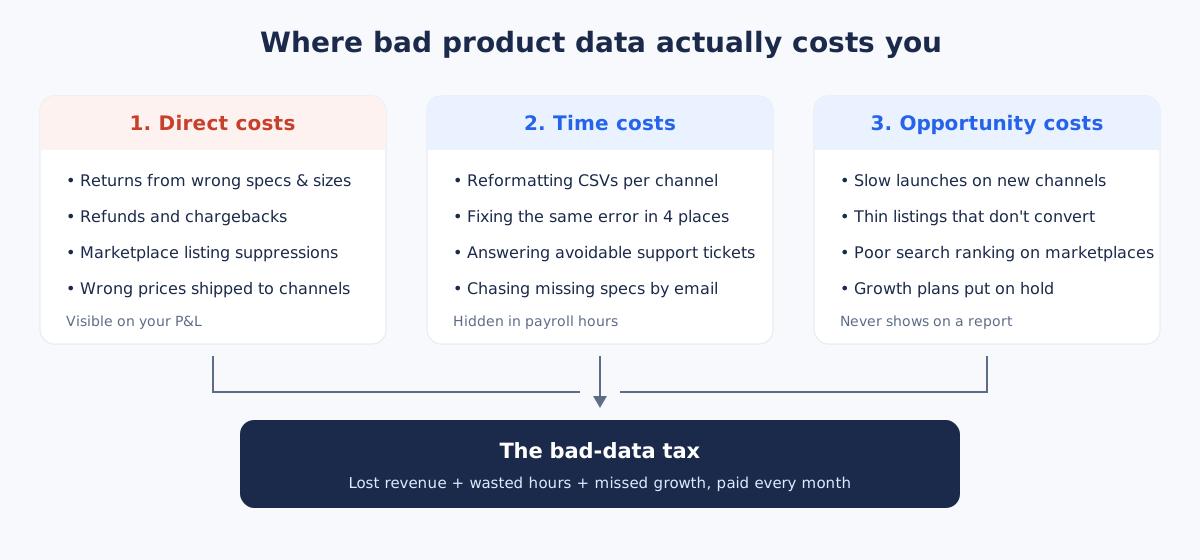
Nobody budgets for bad product data. There's no line item for "revenue lost because our Amazon listing had the wrong dimensions." But the cost is real.
Bad product data has measurable financial consequences. These are the ones that show up if you look for them:
Industry data suggests 5–15% of product returns are driven by inaccurate or incomplete product information. Wrong dimensions, misleading images, missing compatibility details — the product is fine, but the data set the wrong expectations. Each return costs £10–20 in handling alone, before you count lost margin and customer goodwill.
The conversion rate difference between complete and incomplete product pages is stark. Listings with full specifications, multiple images, and detailed descriptions consistently outperform thin listings. Every missing field is a question your customer can't answer — and unanswered questions don't convert.
Amazon, eBay, and other marketplaces increasingly suppress listings with incomplete or inaccurate data. Suppressed listings earn zero revenue. Compliance flags can affect your seller metrics, reducing visibility across your entire marketplace presence.
Time is where bad product data really adds up. These hours don't appear on an invoice, but they're being spent every week:
The maths is straightforward: 200 products across 3 channels, at 5 minutes per update, equals 50 hours per month just on routine updates. That's more than a week of full-time work every month, spent copying and pasting data between platforms.
Every data error creates cascading corrective work. A wrong price on Amazon means a customer complaint, a refund, and a manual correction. Multiply by the number of errors per month and you have a significant hidden workload that never appears on anyone's to-do list.
Launching a new sales channel should be exciting. Instead, it means weeks of auditing your existing data, cleaning it up, reformatting it to meet the new channel's requirements, and filling in all the gaps you've been ignoring. The data preparation often takes longer than the technical integration.
"Where's the latest pricing?" shouldn't take 15 minutes. But when product data lives in multiple spreadsheets, email threads, and platform dashboards, finding the current, correct version of anything becomes a treasure hunt. These micro-delays add up across every person who touches product data.
Perhaps the biggest cost of bad data is what it prevents you from doing:
When product data isn't ready, launches slip. Every day a product isn't live is a day of lost revenue. If your data process adds a week to every launch, multiply that by the number of products you launch per year.
How many sales channels have you considered but haven't pursued because the data work is too daunting? Each unlaunched channel is revenue you're not earning. The barrier isn't usually technical — it's the product data preparation.
Every hour your team spends on manual data management is an hour they're not spending on growth. Marketing campaigns, customer relationships, new product development — all take a back seat to the grind of keeping product data accurate.
The total cost of bad product data is specific to your business. Here's a framework for estimating it:
Track how many hours per week your team spends on product data management — updating channels, fixing errors, searching for information, preparing data for new products. Multiply by your loaded hourly rate. For most multi-channel businesses, this is 10–20+ hours per week.
Count the number of data-related errors per month: wrong prices, incorrect descriptions, missing information that led to returns or complaints. Estimate the cost per error (return handling, refund, customer service time, lost margin). Even a conservative estimate of 5 errors per month at £50 each is £3,000 per year.
Estimate the revenue from channels you haven't launched, products you launched late, and growth activities your team couldn't pursue. This is the hardest to quantify but often the largest number. Even modest estimates add up quickly.
For most multi-channel businesses, the total is surprisingly high — often several thousand pounds per month. Even for smaller operations, the combined time, error, and opportunity costs typically exceed the cost of a proper data management system many times over.
The root cause of bad product data is almost always the same: data that is scattered, unstructured, and manually managed. The fix follows directly from the diagnosis.
Centralise your product data in a single system with built-in quality tracking. A Product Information Management system (PIM) gives you:
The time savings typically cover the cost of a PIM within the first month or two. The revenue impact — from better listings, faster launches, and more channels — builds over weeks and months. If you're unsure whether it's the right move, take the quick assessment.
TidySKU gives you a centralised product catalogue with completeness tracking, structured attributes, and channel-ready exports. Import your existing data from CSV, see what's missing, and start fixing it systematically. Free for up to 50 products — no credit card required.
Time savings are immediate — from day one, you're spending less time on manual data management. Revenue impact builds over weeks and months as your product data improves, listings become more complete, and channel consistency increases. Most businesses see the PIM paying for itself within the first one to two months from time savings alone.
That's actually the best time to implement a PIM. Import what you have — however messy it is — and use completeness tracking to see the gaps clearly. Then improve systematically, starting with your top sellers. A PIM gives you the visibility and structure to clean up progressively rather than trying to fix everything in one heroic effort.
It's proportional but still significant. If someone on your team spends 10 hours a week on manual data management, that's a quarter of their time. For a small business, that person is probably doing three other jobs too — so the opportunity cost is even higher. The cost of bad data doesn't scale linearly with company size; it hits small businesses disproportionately hard.
Start free with 50 products. Get your data right from day one.
Create your free account