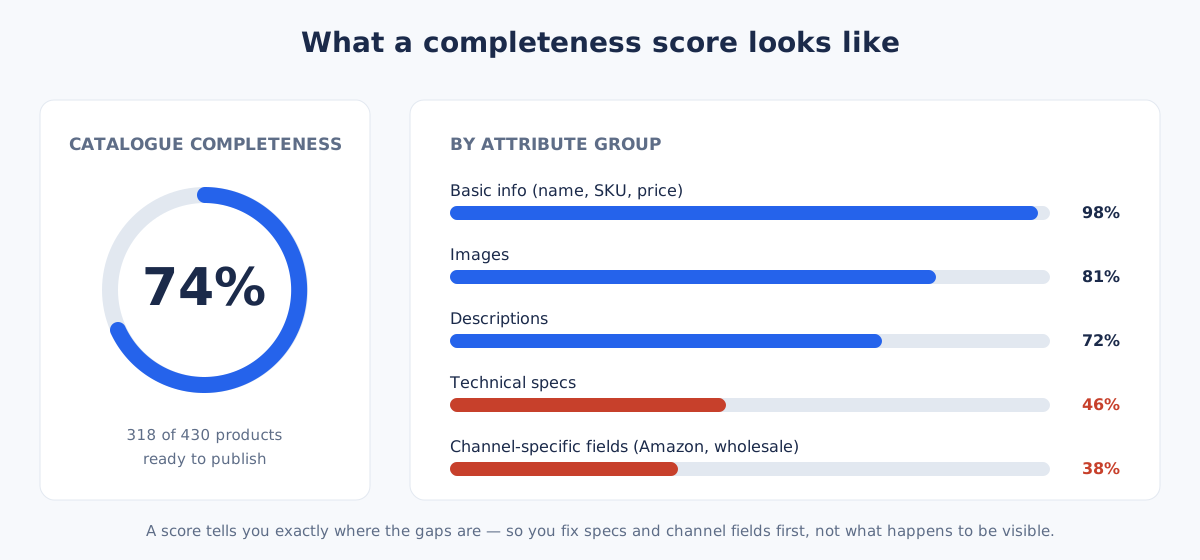
Here's a question most product-based businesses can't answer: what percentage of your products have complete, ready-to-sell data? Not approximately. Actually complete. If you don't know, you're not alone.
A product is "complete" when every piece of information a customer, channel, or internal process needs is present, accurate, and up to date. That sounds simple. In practice, completeness covers more ground than most people expect:
A product with a title and a price isn't complete. A product with all of the above is. The gap between those two states is where sales are won or lost.
Incomplete product data affects your business at every stage:
When a shopper can't find the information they need — dimensions, materials, compatibility — they don't buy. They leave. Incomplete listings create doubt, and doubt kills conversion. Every missing field is a question your customer can't answer.
When a product arrives and doesn't match expectations, it comes back. Inaccurate or missing specifications are one of the top drivers of returns. The product might be fine — the data just didn't set the right expectations.
Launching a new product should be exciting. Instead, it's often a scramble to fill in missing data at the last minute. Incomplete data at onboarding means delayed launches, rushed descriptions, and products going live half-baked.
When data is incomplete in different ways on different channels, customers see conflicting information. Your website says one thing, Amazon says another. That inconsistency erodes trust — and trust is hard to rebuild.
Search engines favour rich, structured content. Products with complete data — detailed descriptions, specifications, proper categorisation — rank better than thin listings. Incomplete data means lower visibility, which means fewer customers finding you.
You can't improve what you don't measure. Here's a practical approach to scoring your product data completeness:
Different product types need different data. A clothing item needs size, colour, material, and care instructions. An electronics product needs specifications, compatibility, and certifications. Define what "complete" means for each category in your catalogue.
For each product, calculate the percentage of required fields that are filled in. If a product has 20 required fields and 15 are populated, that's a 75% completeness score. Simple, objective, and actionable.
Roll individual scores up to see your overall catalogue completeness. What percentage of products are at 100%? How many are below 80%? Where are the biggest gaps by category or supplier?
Define what's acceptable. A common approach: 100% of required fields to publish on any channel. 90%+ overall for products that are live. Below 80% triggers enrichment priority. These thresholds give your team clear targets.
Doing this manually in a spreadsheet is tedious. It's one of the key reasons businesses move to a PIM — automated completeness scoring turns a painful audit into a live dashboard.
When you start measuring, certain patterns emerge. These are the most common completeness gaps we see:
Products with one low-quality image, or no image at all. Marketplaces increasingly require multiple images from different angles. Your customers expect them everywhere.
"Nice blue shirt" is not a product description. Missing details about fabric, fit, care instructions, or use cases leave customers guessing — and guessing customers don't convert.
Weight, dimensions, materials, and technical details that were never filled in. Often because the data exists somewhere — a supplier PDF, an old email — but never made it into the product record.
Products that are complete for your website but missing Amazon-specific fields like bullet points, search terms, or category attributes. Each channel has its own definition of "complete."
The parent product is complete, but individual variants are missing images, have incorrect prices, or lack size-specific details. Variants are products too — they need complete data.
Knowing where the gaps are is half the battle. Here's how to systematically close them:
TidySKU lets you define required attributes per category, then automatically scores every product against those requirements. Filter your catalogue by completeness, see exactly what's missing, and know at a glance which products are ready to publish. Free for up to 50 products.
100% on required fields before publishing — no exceptions. For nice-to-have fields, aim for 80% or higher. The exact threshold depends on your product category and channels, but anything below 80% overall means you're leaving money on the table through missing information and lower search visibility.
Technically, yes — with COUNTBLANK formulas and conditional formatting. In practice, it's fragile. Every time you add a column, change requirements, or someone edits the wrong cell, the formulas break. A PIM does it automatically and updates in real time as your team works.
Indirectly, yes. Richer, more complete product content tends to rank better in search results. More attributes mean more relevant keywords, more structured data for search engines to index, and a better user experience that reduces bounce rates. All of which search engines reward with higher rankings.
With a PIM, completeness is always visible — you don't need to run a check. Make reviewing the completeness dashboard part of your weekly workflow. Identify gaps, prioritise enrichment for your top sellers, and track the trend over time. It should be a standing item, not an occasional audit.
Import your products and TidySKU shows you exactly what's missing. Free for up to 50 products.
Create your free account