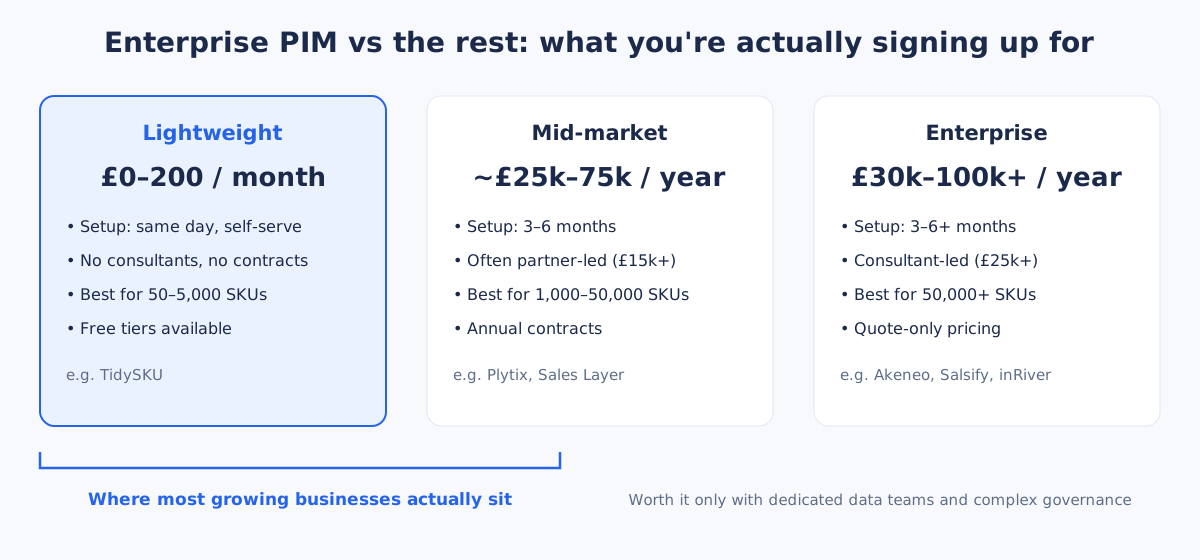
You've decided you need a PIM. You start researching. You land on Akeneo, Salsify, inRiver. Impressive features. Then you learn it's £30,000+/year, months to implement, needs a consultant. You close the tab. Here's the thing: you were right to walk away.
Enterprise PIMs exist to solve genuinely complex problems. They earn their price tag when a business operates at a scale where simpler tools can't keep up:
100,000+ SKUs with deep attribute structures, complex variant relationships, and hundreds of product families.
Multi-language, multi-currency, multi-region data management with locale-specific content for dozens of markets.
Deep two-way connections with ERPs, DAMs, CRMs, PLM systems, and retail partner networks via custom connectors.
Five or more people whose primary job is product data management, with multi-step approval workflows and governance rules.
Pushing product data directly to Walmart, Tesco, Target, and other retail partners through standards like GDSN.
If this sounds like your business, enterprise may be the right fit. But for most companies researching PIMs, it isn't.
Enterprise PIM pricing reflects the full breadth of their platform. But most businesses end up using a fraction of it:
Multi-step, multi-role approval chains with conditional logic. Most teams just need draft and published states.
Inheritance hierarchies, computed attributes, and rule-based enrichment. Powerful, but unnecessary for a straightforward catalogue.
Monitoring your product listings across retail sites for completeness and competitive positioning. A separate problem from managing your data.
Full digital asset management with rights management, format conversion, and creative workflows. Overkill if you just need to attach images.
Managing product content across 30+ languages and locales. Essential for global brands, irrelevant if you sell in one or two markets.
You're paying enterprise prices while using maybe 20% of the platform. That's not smart buying — it's paying for insurance you don't need.
The sticker price on an enterprise PIM is only the beginning. Here's what the total first-year investment actually looks like:
| Cost | Enterprise PIM | Lightweight PIM |
|---|---|---|
| Annual licensing | £30,000–£200,000+ | £0–£2,400 |
| Implementation | £10,000–£50,000+ | £0 (self-serve) |
| Training | £2,000–£10,000 | Minimal (intuitive UI) |
| Ongoing configuration | £5,000–£20,000/year | £0 (self-manage) |
| Time to first value | 3–6 months | Same day |
A typical first-year enterprise PIM investment runs £50,000–£150,000+ when you add licensing, implementation, training, and configuration. And you won't see value for 3–6 months. A lightweight PIM delivers value on day one for less than £2,400/year. For a detailed comparison, see PIM pricing explained.
Modern lightweight PIMs give you the core features that actually matter — at a fraction of the cost, with none of the implementation overhead:
This is what most businesses actually need from a PIM. Everything else is a nice-to-have. Read more about PIM for small business.
To be fair, there are situations where enterprise PIM is the right choice. Consider it if you tick most of these boxes:
If you tick fewer than four, a lightweight PIM is almost certainly the better fit. See how the options compare: TidySKU vs Akeneo and TidySKU vs Salsify.
The smartest strategy isn't to buy the biggest tool "just in case." It's to start lightweight, centralise your data, prove the value, and scale if your business genuinely needs more.
Good lightweight PIMs let you export your data cleanly. That means switching or upgrading is straightforward — you're never locked in. The worst outcome of starting small is that you outgrow it and migrate. The worst outcome of starting enterprise is that you've spent six figures on a tool your team doesn't fully adopt.
Start with the tool that matches your business today, not the one that matches where you hope to be in five years.
Centralised product data, flexible attributes, completeness tracking, multi-channel export, team permissions, and bulk editing. Free for up to 50 products. Set up in minutes, not months.
Akeneo Community Edition is free but self-hosted, meaning you're responsible for servers, upgrades, security patches, and database maintenance. It also lacks many features available in their paid tiers. For most small businesses, a cloud-hosted lightweight PIM is simpler, cheaper to run, and faster to set up.
Possibly, but most businesses find a lightweight PIM serves them well for years. And because good PIMs let you export your data cleanly, moving up to a larger platform is straightforward if you ever need to. Don't buy enterprise "just in case."
Basic integrations — CSV import/export, channel-specific exports, Shopify sync — are standard in lightweight PIMs. Deep API access and custom ERP/CRM connectors are where enterprise platforms have an edge. But most businesses don't need those integrations on day one.
Start free. Scale when you're ready. No enterprise contract needed.
Create your free account